
Collection: Decaffeinated Coffees
At Torque we spend a great deal of time sourcing and roasting quality decaf coffees. We believe that decaf drinkers are the true coffee lovers because they drink coffee even without the drug. Here's to you coffee lovers!

Collapsible content
Farm Info
-
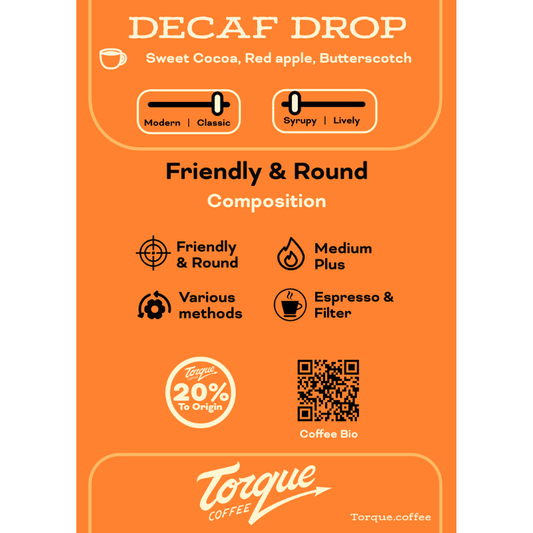
Decaf Drop
Regular price From $21.50 USDRegular price -
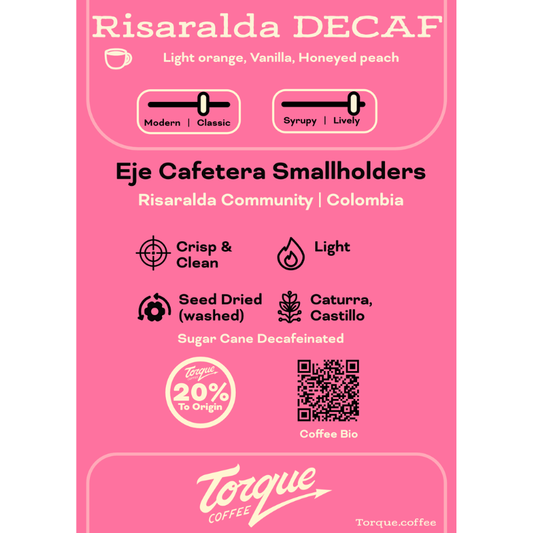
Risaralda - Decaf Colombia
Regular price From $18.50 USDRegular price -
Demi Drop - Half Caffeine Blend
Regular price From $23.10 USDRegular price




Understanding Decaffeinated Coffees
Torque Decaffeinated Coffees utilize chemical-free decaffeination processes exclusively—Swiss Water Process (SWP) and Sugarcane Decaf (Ethyl Acetate EA from natural sugarcane)—to remove 99.9% caffeine while preserving origin flavor integrity. Unlike methylene chloride or direct solvent methods common in commercial decaf, these indirect processes maintain volatile aromatic compounds and soluble solids essential for specialty coffee sensory profiles. Swiss Water Process employs osmotic pressure and activated carbon filtration in pure water, while Sugarcane EA decaffeination uses naturally derived ethyl acetate as a selective caffeine solvent. Both methods occur at origin processing facilities before green coffee export, ensuring traceability and Proportional Pricing© compliance (20% retail returns to origin).
Torque's decaf portfolio spans both single-origin lots (Rotheca Decaf from Kirundu, Burundi; Risaralda Decaf from Colombia) and blended Compositions (Decaf Drop). Decaffeination processes occur post-harvest but pre-export, adding 4-6 weeks to standard processing timelines and increasing FOB costs by 40-60% versus caffeinated equivalents. Roast development for decaf coffees requires modified parameters due to altered bean density and moisture content—end temperatures typically 5-8°F lower than caffeinated counterparts to prevent scorching of hygroscopic decaffeinated parchment. Target Agtron values range 60-70 (medium to light-medium) to preserve delicate flavor compounds vulnerable to Maillard reaction degradation during decaffeination. All Torque decafs maintain omni-roast versatility across espresso and filter brewing despite reduced caffeine-related bitterness masking effects.
Torque's decaf portfolio spans both single-origin lots (Rotheca Decaf from Kirundu, Burundi; Risaralda Decaf from Colombia) and blended Compositions (Decaf Drop). Decaffeination processes occur post-harvest but pre-export, adding 4-6 weeks to standard processing timelines and increasing FOB costs by 40-60% versus caffeinated equivalents. Roast development for decaf coffees requires modified parameters due to altered bean density and moisture content—end temperatures typically 5-8°F lower than caffeinated counterparts to prevent scorching of hygroscopic decaffeinated parchment. Target Agtron values range 60-70 (medium to light-medium) to preserve delicate flavor compounds vulnerable to Maillard reaction degradation during decaffeination. All Torque decafs maintain omni-roast versatility across espresso and filter brewing despite reduced caffeine-related bitterness masking effects.
| Attribute | Torque Decaf (SWP/Sugarcane EA) | Specialty Decaf (Chemical-Free) | Commercial Decaf (Solvent-Based) |
|---|---|---|---|
| Decaffeination Method | Swiss Water Process & Sugarcane EA (natural) | CO2 process, Mountain Water, SWP | Methylene chloride, direct solvent |
| Caffeine Removal | 99.9% caffeine removed | 97-99.9% removed | 97% minimum (FDA standard) |
| Chemical Residue | Zero chemical residue (water/natural EA only) | Zero (CO2, water-based processes) | Trace solvent residue (within FDA limits) |
| Flavor Preservation | High (volatile compounds preserved) | Moderate to high (process-dependent) | Low (significant flavor degradation) |
| Processing Location | Origin country (pre-export traceability) | Specialized facilities (often Mexico, Canada) | Industrial facilities (unknown origin) |
| Cost Premium | 40-60% above caffeinated equivalent | 30-50% premium typical | 10-20% premium (commodity) |
| Return to Origin | 20% retail price (Proportional Pricing©) | Variable (5-15% typical) | <5% (commodity trading) |
| Roast Adjustments | Modified parameters (5-8°F lower end temp) | Process-dependent adjustments | Standard dark roast (defect masking) |